Loading...
-
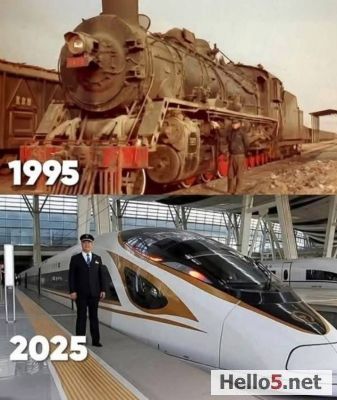
 Turgut Can uploaded 1 new photo to Newsfeed Photos albumThis photo shows the evolution of trains in China over the past 30 years, and the engineer in the images is the same person. In 1992, Han Junjia was a young apprentice on a steam locomotive. The noise was deafening, the hot steam burned his face, and the soot followed him even into his sleep. He witnessed an era that was fading away, but also the beginning of a new one. Three years later, in 1995, Han became a diesel train engineer. For the first time, the cabin had a small luxury — a rear-view mirror and a rudimentary monitoring system. But the roar of the engines was so loud that engineers had to shout to hear each other. The real revolution came in 2008, when China electrified its railway lines. Trains began reaching 160 km/h, and the noise was replaced by an almost unreal calm. The journey became smoother, quieter — and, in a way, more human. In 2010, Han boarded a high-speed train for the first time. He said he felt as if he were in a spaceship. And in 2017, he took command of the Fuxing train, the symbol of Chinese modernity, which flies at 350 km/h. Throughout his career, Han Junjia obtained eight different licenses and personally experienced the transformation of an entire country. Today, when he looks at the digital control panel of his ultra-fast train, he remembers the steam, the diesel roar, and the cold meals eaten between stops. And he smiles.This photo shows the evolution of trains in China over the past 30 years, and the engineer in the images is the same person. In 1992, Han Junjia was a young apprentice on a steam locomotive. The noise was deafening, the hot steam burned his face, and the soot followed him even into his sleep. He wit...See more
 Nov 24, 21:420 3


